NPS Fort Pulaski National Monument in Tybee Island Georgia - The April 1862 Battle for Fort Pulaski in was a turning point in military history featuring the first significant use of rifled cannons in combat.
Fort Pulaski Preservation
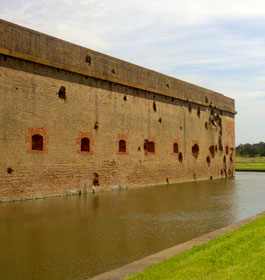
These accurate, long-range weapons shattered Fort Pulaski's walls from over 1 mile away. After 30 hours of bombardment, the fort surrendered. The battle surprised military strategists worldwide, signaling the end of masonry fortifications.
In 2007, Fort Pulaski National Monument implemented a fee demonstration project that began to address the enormous preservation challenges that face a park with a 160 year old brick fort and associated historic structures. Partnering with an existing park maintenance staff of five and utilizing the STEP authority, a National Park Service program that allows for the hiring of student employees, the park hired six talented undergraduate and graduate students majoring in historic preservation from the Savannah College of Art and Design (SCAD) to form this first ever park preservation team.
The main focus of the team's work was to focus on reducing the amount of deferred maintenance within the walls of the fort, tuck-pointing deteriorated mortar joints, as well as maintaining the historic Cockspur Island Lighthouse.
Tuck-pointing and repairing old mortar joints remains one of the team's major focus inside Fort Pulaski. In the 1930s the Civilian Conservation Corps (CCC) repaired crumbling mortar joints inside the fort using the latest technology, Portland cement, without knowing its damaging effects. However, Portland cement does not allow lime mortar to absorb and release moisture. Thus, the lime mortar is reduced to powder. The weakening mortar leads to cracking and flaking of historic bricks which threatens the overall integrity of the fort.
With more than 25 million bricks, today’s challenge for the preservation team involves removing the Portland cement and replacing it with the more traditional lime mortar and natural cements that would have been used during the construction of the fort.
In April 2008, the team traveled to Charleston, South Carolina to participate in the "Preserving Coastal Forts: a National Park Service Workshop" hosted by Fort Sumter NM. On the first day of the workshop, participants visited Fort Moultrie, where demonstrations by masons from the Historic Preservation Training Center (HPTC) and the team from Fort Pulaski, offered the participants "hands-on" learning about historic mortars.
In just a little over a year, work by the preservation team has visibly improved the brick walls of Fort Pulaski and the Cockspur Island Lighthouse. When visiting the park take a look at the fort's southwest bastion to get a close-up view of the work being done.
Things to Do
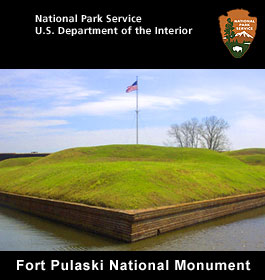
Fort Pulaski National Monument offers visitors the chance to experience many interesting and exciting activities year-round. Fort Pulaski itself is a large-scale outdoor exhibit. The main structure, together with outlying works including demilune, drawbridges, ditches, and dikes, is a fine example of historic military architecture.
Guided Tours
Fort Pulaski National Monument offers guided tours Monday thru Friday at 11:00 AM and 3:00 PM. Tours may vary on Saturdays. Through the tour, visitors will see one of the nation’s finest examples of a seacoast fort, while learning about the construction and engineering of Fort Pulaski, Civil War technology, rifled cannons, general fort life, and the Battle for Fort Pulaski in 1862. Tours meet inside the fort and usually last 45 minutes.
Fort Pulaski National Monument Indoor Activities Visitor Center and Museum
Indoor exhibits highlight the history of Fort Pulaski from the fort's construction, to its eventual fall due to advancing military technology.
Exhibits inside the Visitor Center highlight Casimir Pulaski, General David Hunter, and Robert E. Lee. Learn about the construction of Fort Pulaski and the signifigance of the battle for Fort Pulaski in April 1862. Recent additions include a new high-definition presentation detailing the historic battle , as well as a full-scale replica of a 13-inch Seacoast Mortar.
"The Battle for Fort Pulaski," a 17 minute film highlights the history of Fort Pulaski from its early construction to the later struggle for its control during the Civil War. Film shows on the hour and half-hour from 9:00AM to 4:30PM daily.
Restrooms, water fountains, and bookstore are all located in the visitor center complex. Sutler Store located inside historic Fort Pulaski.
Fort Pulaski Outdoor Trails and Activities
We hope your visit is the experience of a lifetime. Whatever your interest—sightseeing, hiking, kayaking, bicycling, exploring, history, nature study, or photography— you will find Fort Pulaski National Monument like no other place.
Fort Pulaski offers an abundance of outdoor activities including hiking, biking, and bird watching. Fishing is allowed along the banks of the Savannah River on and around Cockspur Island, including the use of the Cockspur Island Bridge after hours. You must possess a valid fishing licence issued by the State of Georgia. Outdoor enthusiasts will enjoy exploring several nature trails throughout Fort Pulaski National Monument. Selected trails include:
North Pier Trail - This trail guides visitors through a scenic wooded environment and passes through remnants of Fort Pulaski's original construction village. Battery Hambright, built in the late 19th Century, and the historic north pier highlight this 1/4 mile trail.
Lighthouse Overlook Trail - The Lighthouse Overlook Trail guides visitors along open marsh as well as a forested environment offering views of the Savannah River, and Tybee Island. The 3/4 mile trail also offers the island's best views of the historic Cockspur Island Lighthouse.
Historic Dike System - Designed by Lt. Robert E. Lee, the historic dike system allowed for tide control and drainage which aided in the construction of Fort Pulaski. The two mile length trail circles Fort Pulaski, offering visitors unparalleled views of Cockspur Island and the Savannah River.
McQueens Island Rails to Trails - Located on McQueens Island at the entrance to Fort Pulaski National Monument, this six- mile trail follows the path of the old Tybee rail line that once connected Savannah Georgia to the beaches of Tybee Island. The packed-gravel trail is open to bikers, runners, and walkers.
Picnic Area - Come enjoy Fort Pulaski National Monument's picnic grounds. Both covered and outdoor area let you and your family sit back and relax on beautiful Cockspur Island.
Battery Hambright - Explore Battery Hambright, built to protect the entrance of the Savannah River in the late 19th century during the Spanish-American War.
John Wesley Memorial - Landing on Cockspur Island in 1736, John Wesley is said to have preached his first sermon in the new world nearby. Today, a monument stands to honor his passing through Cockspur Island.
Construction Village - Look closely for remnants of Fort Pulaski's construction village used from the late 1820s through the 1880s. You can view the ruins of ovens, cisterns, and other stonework dispersed along the park trails.
Cemetery - View the small cemetery located next to Fort Pulaski. The final resting spot of several soldiers from the early to mid-19th century.
Phone & Directions
Phone: Visitor Information - 912-786-5787
Directions: From I- 95, take exit for I-16 about 15 miles west of Savannah Georgia. From I-16, take U.S. Highway 80 East. Follow signs for Fort Pulaski, Tybee Island and beaches. Fort Pulaski National Monument entrance is approximately 15 miles east of Savannah Georgia.
Operating Hours, Seasons & Phone Contact
Fort Pulaski National Monument is open daily from 9:00 AM to 5:00 PM. Park hours may vary during the summer. Fort Pulaski National Monument is closed on Thanksgiving Day and Christmas Day. Regular Hours:
Visitor Center open 9 AM-5 PM
Fort open 8:30 AM-5:15 PM
Bridge gate closes by 5:30 PM Summer Hours: (Memorial Day - mid-August)
Visitor Center open 9 AM-5:30 PM
Fort open 8:30 AM-6:30 PM
Bridge gate closes by 6:45 PM
*Please be aware of park hours and closing times. Remember! All vehicles must be across the Cockspur Island Bridge by closing time.
Fees & Reservations
Individual Fees $3 entrance fee charged for all visitors 16 years of age and older. 15 years old and under free. Receipt valid for additional 6 days of visitation. Teachers desiring an educational fee waiver must submit the request one month prior to the group's anticipated visit.
Directions to Fort Pulaski
From I- 95, take exit for I-16 about 15 miles west of Savannah Georgia. From I-16, take U.S. Highway 80 East. Follow signs for Fort Pulaski, Tybee Island and beaches. Fort Pulaski National Monument entrance is approximately 15 miles east of Savannah Georgia.
Interesting Fort Pulaski National Monument Facts
An estimated 25 million bricks were used to construct Fort Pulaski. Many of the bricks, known as Savannah Gray, were handmade at the Hermitage Plantation on the Savannah River. Other bricks arrived from Virginia and Maryland.
The breach made in Fort Pulaski's southeast corner was repaired within six weeks following the battle by Union forces.
Many of the bricks used to construct Fort Pulaski were handmade and shipped from the Hermitage Plantation that was located along the Savannah River.
The American Alligator is native to coastal Georgia and can often be found lurking in the wet ditch or moat surrounding Fort Pulaski. Watch your step!
Members of the 48th New York Volunteers stationed at Fort Pulaski played baseball to pass the time. 1 of the first photographs taken of the game of baseball was captured at Fort Pulaski in 1862.
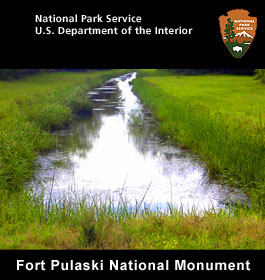
The wet ditch, or moat, that surrounds Fort Pulaski varies in width from 30 to 48 feet, and has an average depth of eight feet. Alligators, turtles, and small marine life inhabit the moat.
Fort Pulaski was named for Count Casimir Pulaski, a Polish nobleman who was mortally wounded while helping American forces battle for control of Savannah Georgia in 1779.
Hundreds of bottles were recovered from Ft. Pulaski's moat during CCC excavations in the 1930s. Many of these well-preserved bottles date to the construction of the fort and later Civil War.
Fort Pulaski was used as a prison during the American Civil War holding more than 500 Confederate prisoners during the winter of 1864.
The First National Flag of the Confederate States of America, or the "Stars and Bars," flew over Fort Pulaski for nearly 15 months during the Civil War.
You can take in an early game of baseball or "rounders" when visiting Fort Pulaski. Park staff and volunteers often enjoy playing baseball inside the fort like Union soldiers did during the Civil War.
The demilune, a triangular piece of land designed to protect the rear of Fort Pulaski, illustrates modifications made during the 1870s for the future installation of 25 ton guns.






























 Prepare for your trip to