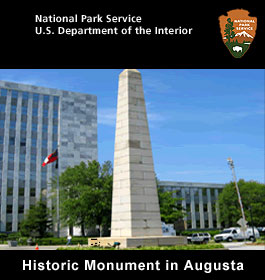
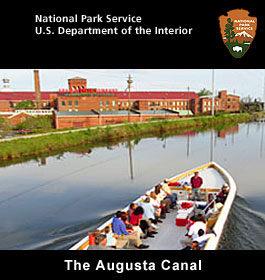
Augusta Georgia National Park Historic District - Visit the historic commercial area centered on Broad Street, industrial properties along the Savannah River, railroad, governmental, religious, and residential areas along Greene and Telfair Streets.
Downtown Augusta Historic District Info
The city was laid out in 1736 in a gridiron plan with major streets set parallel to the river. Broad Street between 5th and 13th Streets is the historic commercial corridor with rows of continuous commercial blocks and a contemporary landscaped median. Greene Street is a tree-lined boulevard with a historic park-like center median.
Government buildings, churches, and large houses of Augusta’s 19th century elite line the street. Telfair Street, the third principal avenue in the historic district, includes some commercial buildings but mostly features community landmark buildings, such as the Academy of Richmond County and the Old Medical College of Georgia. Ellis Street, a secondary thoroughfare, is lined with commercial buildings and provides service access to the buildings on Broad and Greene Streets.
The district contains a large intact collection of architecturally significant buildings in a variety of styles constructed from 1801-1967. Architectural styles illustrate the evolution of architecture in Georgia from its early settlement along the fall line in the 18th century through the mid-20th century. Historic buildings in the district include some of the state’s best examples of the Federal (Old Government House, Gertrude Herbert Institute of Art), Greek Revival (Old Medical College of Georgia), Gothic Revival (Academy of Richmond County), Romanesque Revival (First Presbyterian Church, Sacred Heart Catholic Church), Italianate (Joseph Rucker Lamar Boyhood Home), Second Empire, Queen Anne (Augusta Cotton Exchange Building ), Beaux Arts (First Baptist Church), Classical Revival (Lamar Building), Craftsman, Art Deco, and International styles.
Throughout its history as the commercial heart of Georgia’s second oldest city, Broad Street has played various roles in the city’s development. Because Augusta Georgia is a river town, trade came naturally to its early settlers making it a trading center. Trade links with the Indians raised the frontier town above the status of a garrison. Later, with the influx of Virginians, tobacco was introduced and became the staple crop of the Augusta Georgia area from c. 1770 to 1800. After the invention of Eli Whitney’s cotton gin in 1793, cotton outstripped tobacco as the principal cash crop until the early 20th century.
The coming of the railroad in the 1830s strengthened both the economic role of Augusta Georgia in the region and the commercial role of Broad Street in the city. Along with new industry and increased trade came additional retailing of goods and services. During the first half of the 20th century, established business traditions continued along Broad Street. Three new developments along Broad Street were the skyscraper (Lamar Building), the department store, and the movie theater. A revitalization effort is apparent along this main corridor with its new shops, loft apartments, restaurants, and art galleries opening.
Noteworthy landscape architecture is evident on Greene Street, one of downtown Augusta’s three main east-west streets. Greene Street is an excellent example of a 19th century urban park-like boulevard and is among the state’s longest landscaped avenues outside of Savannah. Named for Revolutionary War hero Nathaniel Greene, the street has two parallel roadways divided by a central median. Elm and oak trees now line the median originally shaded by oak, elm, and dogwood trees. It features open green spaces, azaleas, walks, benches, and commemorative monuments. Trees, grass, and sidewalks also border the perimeter of the street.
Downtown has always been important in politics and government because Augusta Georgia is the county seat of Richmond County, and the district includes buildings and structures directly related to the functions of the local county government and the Federal Government. The 1820 courthouse was demolished in 1957 to make way for the current Municipal Building which includes the county’s court functions. The Federal Government is represented by the c. 1916 United States Courthouse, on East Ford Street. The monumental size and scale of these buildings reflect the importance of government in Augusta Georgia throughout the 20th century.
Downtown Augusta Georgia is home to three historic schools, two of which have statewide importance. The Academy of Richmond County is among the first educational institutions established in Georgia. The Old Medical College of Georgia building represents the state’s first efforts to advance the understanding of human anatomy and physiology and train physicians in the practice of medicine. The John S. Davidson School illustrates the development of the public school system in Augusta Georgia and Richmond County.
The period of significance for the district begins in 1736 when Augusta’s gridiron plan was laid out and ends in 1967 to include the Miesian style Georgia Railroad Bank Building, a black steel and glass office tower erected following the boom years in which federal projects boosted the city’s population and building construction downtown.
Augusta Downtown Historic District is roughly bounded by13th St., Gordon Highway, Walton Way, and the Savannah River. The district contains many buildings open to the public and a number of private homes not open to the public. The Broad Street Stores, First Presbyterian Church, Greene Street Historic District, Murphey House (Richmond County Courthouse), Old Medical College (a National Historic Landmark), Phinizy Residence, Platt-Fleming-Walker-d’Antignac House, Sacred Heart Church, St. Paul’s Church, St. Paul’s Parish Cemetery Gate & Gravestones, Ware-Sibley-Clark House, Woodrow Wilson Boyhood Home, and Zachary Daniels House have been documented by the National Park Service's Historic American Buildings Survey.
Contact and Address Info
Phone: 706-823-0440 ext. 4, 800-659-8926 - Address: 1450 Greene Street, Suite 400, Augusta, GA 30901
Interesting Augusta Canal Facts
Congress has established 40 National Heritage Areas around the country in which conservation, interpretation and other activities are managed by partnerships among federal, state, and local governments and the private sector.






























 History