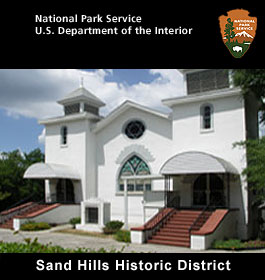
Discover Augusta's Sand Hills Historic District - Sand Hills Historic District, also known as Elizabethtown, is a historically black neighborhood adjacent to Summerville Historic District.
Sand Hills Historic District
In 1887 the Augusta Chronicle described the neighborhood, referring to it as Elizabethtown, as “a little hamlet just above Summerville.”
The white community gave the neighborhood its original name in honor of Elizabeth Fleming. “Miss Lizzie” was a daughter of Porter Fleming, a white wholesale grocer in Augusta, who after many years as a missionary returned to Summerville. The Fleming plantation, “Westover,” was on the northwest edge of the district. The Community Development Department of Augusta gave the district the name, “Sand Hills," in the 1970s, but this was a historically accurate name for the Summerville settlement as early as the 18th century.
The neighborhood’s historical development is closely associated with that of Summerville, which was a summer retreat before it became a permanent neighborhood for prominent Augustans and Northerners. Summerville residents, including the Cumming and Fleming families and Judge William Watts Montgomery Jr., owned the Sand Hills land. Soon after the end of the Civil War, black residents settled into the area. They were primarily unskilled laborers and domestic servants working for the white homeowners nearby.
The district is significant in community planning and development for the design of the gridiron plan and narrow land lots, the development of commercial stores at street crossroads and junctions, establishment of a community school, and for its late 19th and early 20th-century residences. Important historic manifestations of landscape architecture include examples of swept yards that were popular with African Americans, uniformly setback houses, and the blending of trees and shrubbery in front yards to create an informal setting.
The historic residential, commercial, and community landmark buildings are very diverse in type and styles such as Shotgun, Craftsman, English Vernacular Revival, Colonial Revival, Dutch Colonial Revival, Spanish Colonial Revival, and Minimal Traditional.
The variety of buildings is partially due to the passage of a 1913 city ordinance that imposed racial zoning. Housing stock prior to 1913 consisted of modest homes. After passage of the ordinance, a greater number of African Americans moved into the neighborhood. These new arrivals included a large number of middle-class African Americans, who built larger homes representing various popular styles.
Several businesses, churches, a school, and restaurants provide for the needs of those living in the district. Remaining historic churches include Cumming Grove Baptist, built in 1867 and rebuilt in 1915, and the c. 1890 Rock of Ages Christian Methodist Episcopal Church. Federal Emergency Admin. of Public Works funded construction of Weed School for residents of the neighborhood in 1936 to accommodate the increase in the student population from the area it served.
Summerville Black Cemetery on Fitten Street is one of the oldest black cemeteries in Augusta. Among those buried are Willie Mae McNatt, Augusta’s first black juvenile court officer; Canute M. Richardson, an interim president at Paine College; and several members of the Dent Family, who founded Dent’s Undertaking Establishment, one of the oldest black mortuaries in Augusta.
Sand Hills Historic District is bounded roughly by Monte Sano Avenue on the west, North View Avenue, and Mount Auburn Street on the south, Johns Road on the east, and the Augusta Country Club on the north.






























 History